EU to expand support for adolescent, maternal health in Kwara
By Fatima Mohammed-Lawal
The European Union (EU) has reiterated commitment to expand its support for reproductive and adolescent health services in Kwara under the EU Strengthening Access to Reproductive and Adolescent Health (EU-SARAH) programme.
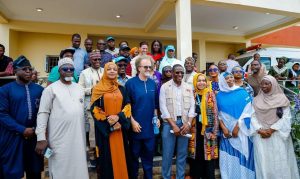
The Head of Cooperation, EU Delegation to Nigeria and ECOWAS, Mr Massimo De Luca, disclosed this on Friday in Ilorin during an assessment visit to health facilities and communities benefiting from the programme in Kwara.
The News Agency of Nigeria (NAN) reports that the EU-SARAH programme is funded by the EU and implemented by the United Nations Children’s Fund (UNICEF) and the United Nations Population Fund (UNFPA) in Kwara, Sokoto and Adamawa.
De Luca said the programme was designed to support government efforts rather than take over its responsibilities.
“We are here to support the government. We are not replacing government. If government is not moving, we cannot move,” he said.
He said the success of the programme depended largely on government commitment and leadership.
According to him, needs and circumstances differ across the three states.
He, however, noted that Kwara is in a privileged position because of the access the programme has at the grassroots, including engagement with volunteers, civil society organisations and communities.
He commended the state government for prioritising health, particularly issues affecting mothers and children, saying the commitment had created strong synergy between government and development partners.
De Luca also commended UNICEF, UNFPA and other implementing partners for reaching adolescents with services covering prenatal and postnatal care, family planning and other reproductive health needs.
“The programme is important because health challenges among adolescents could affect their education and future if not properly addressed,” he said.
He explained that some adolescents facing health challenges could drop out of school, become vulnerable or lose their lives.
De Luca urged communities to pay attention to how adolescents were catered for at Primary Healthcare Centres (PHCs), including access to assistance and commodities.
He highlighted the flexibility of the programme in responding to emergencies, adding that adolescents affected by attacks in some communities in February received support through the intervention.
He said the EU delegation was looking at expanding support for the programme in Kwara, Sokoto and Adamawa, in collaboration with the Federal Government.
Speaking earlier, the Kwara Commissioner for Health, Dr Amina El-Imam, described EU-SARAH as a major partnership for the state.
El-Imam said the programme had improved capacity of health workers, increased demand for family planning services and strengthened awareness on reproductive and sexual health.
She said visits to facilities and communities showed that the intervention was changing the way residents accessed healthcare.
The commissioner stressed the importance of male involvement in family planning, saying increased support from men had helped women access services without seeking them secretly.
She urged women to carry their spouses along in family planning decisions, while calling on men to sustain support.
Also, the Chairman, Ward Development Committee (WDC), Balogun Fulani community, Alhaji Ibrahim Balogun, said the intervention had brought significant changes to the community.
Balogun said the programme created greater awareness on the importance of using health facilities, particularly for antenatal care and childbirth.
According to him, residents who previously relied on home deliveries and traditional practitioners are increasingly seeking professional medical care.
He added that the intervention also supported awareness on child abuse, Gender-Based Violence, rape and other social problems affecting children and adolescents.
He said proximity of the PHC had encouraged pregnant women to seek care, as the facility was easily accessible.
Balogun expressed appreciation to the EU and other development partners for the intervention, saying its impact was visible in the community. (NAN)