EU Urges Kwara Govt. to Increase Maternal Healthcare Funding
By Fatima Mohammed-Lawal
Ilorin – The European Union (EU) has urged the Kwara Government to increase domestic funding of maternal and neonatal healthcare.
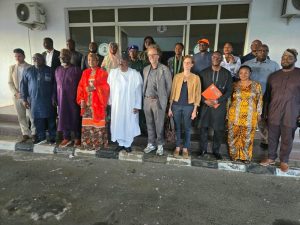
The call was made in Ilorin on Thursday by the Head of Cooperation, European Union Delegation, Mr Massimo Deluca, during an advocacy visit to Kwara.
Deluca said the visit was to evaluate progress after about a year of implementation and assess the state’s advancement with the partners toward agreed targets.
The News Agency of Nigeria (NAN) reports that the delegation includes the EU, United Nations Children’s Fund (UNICEF), United Nations Population Fund (UNFPA), the German Embassy, and other development partners.
Deluca explained that adequate funding would help to sustain improvements recorded in maternal, neonatal, adolescent and youth health services in Kwara.
According to him, Kwara was selected as a pivotal state for its interventions, particularly in adolescent and maternal health.
Deluca noted that the partnership was intended not merely as financial support but as an intervention whose results must be measured.
He added that the EU’s contribution was intended to complement the state’s own efforts.
He emphasised the importance of maintaining close dialogue between the EU and the state government in tracking progress toward agreed targets.
Mr Martin Axel, UNICEF Maternal, Newborn and Child Health (MNCH) Manager, commended the state for its “strong leadership, ownership and accountability in implementing the interventions”.
Axel said the state had demonstrated commitment to the partnership and noted that the experience in Kwara was also encouraging other states implementing the programme.
According to him, community midwifery is a major milestone, and UNICEF will complement the approach with the safer birth bundle care initiative.
“The initiative supports health facilities with capacity to manage preventable deaths among mothers and newborns,” he said.
UNFPA representative, Dr Koessan Kuawu, said the partnership between the UN agencies, the EU and Kwara had produced tangible results despite the relatively short implementation period.
Kuawu attributed the progress to the combination of government leadership and international partnership.
“The experience showed that development interventions can produce concrete results when supported by local ownership,” he said.
He cited health workers’ training, the completion and equipping of 150 health facilities, and efforts to reach people in remote communities among the achievements recorded under the partnership.
Kuawu also commended the state government for providing domestic resources to procure family planning and maternal health commodities.
The Head of Cooperation at the German Embassy in Abuja, Dr Karim Jansen, said the visit reflected a shared commitment to supporting Nigeria’s development priorities.
Jansen said the delegation would also participate in the commissioning of a solar mini-grid project.
It described this as an example of how international cooperation could translate into benefits for communities, businesses and local development.
In his response, Gov. AbdulRahman AbdulRazaq said the state valued its partnership with the EU and welcomed the opportunity to assess how EU-supported investments were benefiting residents.
AbdulRazaq, who was represented by his Deputy, Mr Kayode Alabi, observed that the visit provided an opportunity to review progress.
He highlighted the EU-SARAH initiative and its support for strengthening maternal, newborn, adolescent and youth health services in the state.
According to him, improving health outcomes requires accessible services, support for health workers, improved quality of care and greater attention to the needs of women, young people and communities.
Earlier, the state Commissioner for Health, Dr Amina El-Imam, said the state government’s approach focused on strengthening the health system across the continuum of care.
“The government has improved health infrastructure across the state’s 193 wards.
“This has strengthened primary and secondary healthcare and expanded tertiary healthcare,” she said. (NAN)