Malaria Elimination: KWASU Lecturer Pushes Data-Driven Strategy, Calls for Local Larvicide Trials
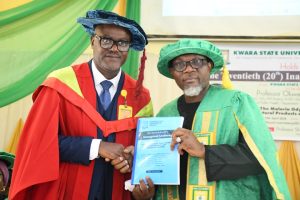
A Professor of Public Health at the Kwara State University, Malete, Oluwasogo Adewole Olalubi, has called for a major shift in Nigeria’s malaria control strategy, urging the Federal Ministry of Health through the National Malaria Elimination Programme (NMEP) to prioritise Kwara State for larvicide field trials as part of an integrated approach to combating Malaria.
Delivering the 20th inaugural lecture titled “The Malaria Odyssey: From Test-tube to Natural Products and Geospatial Modelling,” held on 15 April 2026, the don said Nigeria must move beyond fragmented interventions and adopt a more coordinated, data-driven response to malaria control.
According to him, combining Long-Lasting Insecticidal Nets (LLINs), Indoor Residual Spraying (IRS), and Larval Source Management (LSM) would significantly improve outcomes compared to relying on a single method.
“LSM is ready for implementation and should be adopted as a central pillar to fast-track Nigeria toward malaria elimination. We do not need further delay in research; what is required now is implementation at scale,” Professor Olalubi said.
He stressed the need for innovation and stronger collaboration between researchers and policymakers, noting that indigenous solutions must be prioritised.
The professor also advocated investment in local research and innovation, including diagnostics, vector control tools, drugs, and vaccines, as well as expanded genomic surveillance of Plasmodium and Anopheles species.
“Without effective data, there is no disease control. We must embrace mobile reporting systems, DHIS2 dashboards, and geospatial mapping to guide all interventions,” he added.
Among his recommendations, he urged stronger primary healthcare systems and supply chains to ensure consistent access to Artemisinin-based Combination Therapy (ACT) and Rapid Diagnostic Tests (RDTs), while insisting on mandatory testing before treatment is dispensed.
He further called for community-driven interventions, saying mass distribution of mosquito nets should be replaced with more targeted approaches supported by trained community health workers.
Professor Olalubi also emphasised the need to protect vulnerable groups, including internally displaced persons and persons with disabilities, through mobile clinics and inclusive healthcare services.
On financing, he urged increased domestic funding and private sector participation in malaria control efforts, alongside public-private partnerships to support local production of ACTs, RDTs, and insecticides.
The inaugural lecturer recommended tailored strategies for urban and rural settings, with urban areas focusing on drainage management and IRS, while rural communities should prioritise vegetation control and rotational insecticide use.
He also called for policy reforms and stronger institutional frameworks, including improved tracking of malaria budgets and better integration with national health financing mechanisms.
In a major proposal, he suggested the establishment of a Nigerian Institute of Malaria Studies, to be hosted at Kwara State University, which would serve as a multidisciplinary hub for research, training, and operational science aimed at achieving a malaria-free Nigeria.
“Nigeria can eliminate malaria if we are willing to move from theory to action, from fragmented efforts to coordinated systems, and from data gaps to data-driven decisions,” he added.