KWASU Don Urges Government to Mandate Use of Recycled Materials in Building Projects

The Federal Government has been urged to make the use of recycled and sustainable materials mandatory in construction projects to curb building failures, reduce construction costs and promote environmental sustainability.
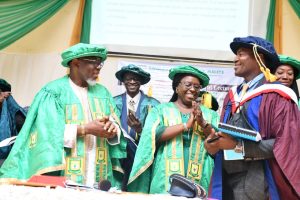
The call was made by Professor Samson Olalekan Odeyemi, a Professor of Structural and Material Engineering at the Faculty of Engineering, Kwara State University (KWASU), Malete, while delivering the university’s 22nd Inaugural Lecture titled, “From Rubble to Resilience: Gathering the Fragments for a New Structural Paradigm,” on Wednesday.
Professor Odeyemi said government policies should require contractors and developers to incorporate a minimum percentage of recycled and sustainable materials in both public and private construction projects.
According to him, such a policy would usher Nigeria into a new era of construction in which buildings are stronger, more resilient and environmentally sustainable.
He identified agricultural waste such as rice husk ash, corn cob ash, sugarcane bagasse ash and palm oil fuel ash as valuable resources that can be transformed into high-performance engineering materials for the construction industry.
The professor explained that although these materials are not primary cement binders, they possess pozzolanic properties that react during cement hydration to produce compounds that improve the strength, durability and long-term performance of concrete.
“The introduction of policies requiring the use of a minimum percentage of recycled or sustainable materials in construction projects will lay the foundation for a new era of building construction in Nigeria where structures are designed for greater strength, resilience and environmental sustainability,” he said.
Odeyemi stressed the need for Nigeria to reduce its dependence on conventional cement by embracing a circular economy that promotes the use of locally available agricultural waste in the production of construction materials.
He noted that appropriate legislation and industry regulations would accelerate the adoption of sustainable materials, reduce environmental pollution and lower construction costs without compromising structural integrity.
Citing research findings, the professor said concrete produced with agricultural waste-derived materials has been shown to meet—and in some cases exceed—conventional engineering standards, while providing a more affordable and environmentally friendly alternative for infrastructure development.
To demonstrate the practical application of the innovation, he pointed to the interlocking paving stones at the entrance of the KWASU Faculty of Engineering, noting that they were produced using rice husk ash and locally sourced fibres.
According to him, the project demonstrates that the technology has advanced beyond laboratory research to real-life application.
Professor Odeyemi also expressed concern that Nigeria’s construction sector remains heavily dependent on conventional building materials, exposing the industry to rising costs, excessive reliance on imports and the environmental impact of carbon-intensive cement production.
He called on the Standards Organisation of Nigeria (SON) and other regulatory agencies to strengthen quality control measures to ensure that only certified construction materials are available in the market, thereby reducing the incidence of building collapse associated with substandard products and poor construction practices.
The professor maintained that wider adoption of sustainable building materials derived from agricultural waste would enhance infrastructure durability, protect the environment, stimulate local industries, create jobs and contribute significantly to Nigeria’s sustainable development goals.