Nigerian Universities Must Move Beyond Survival to Build Resilient Institutions — Oloyede

Emeritus Professor Ishaq Oloyede
Emeritus Professor Ishaq Oloyede, former Vice-Chancellor of the University of Ilorin and former Registrar of the Joint Admissions and Matriculation Board (JAMB), has called for a fundamental transformation of Nigeria’s university system, warning that institutions must move beyond merely surviving recurring challenges to building sustainable, innovative and resilient systems.
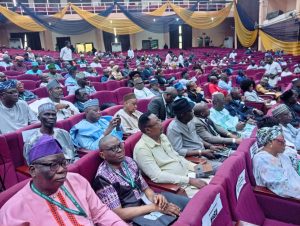
Oloyede made the call while delivering a keynote address on the need to reimagine Nigerian universities in the face of mounting demographic, technological, financial, environmental and social pressures, at the General Assembly of Committee of Vice-Chancellors of Nigerian Universities (CVCNU) holding at UNILORIN.
He said the concept of resilience must not be misunderstood as the ability of institutions and individuals to continuously endure inadequate facilities, poor funding and dysfunctional systems.
According to him, lecturers teaching overcrowded classes without adequate facilities, students studying without reliable electricity or internet connectivity, laboratories improvising without essential equipment and administrators sustaining institutions through personal sacrifice deserve commendation, but such sacrifices should not replace institutional reforms.
He said: “We must not define resilience as the capacity to tolerate recurring dysfunction.”
Oloyede noted that a university that repeatedly loses academic time, cannot protect its records, depends on a few individuals to perform basic functions or collapses whenever there is a funding delay cannot genuinely be described as resilient.
He said Nigerian universities should instead develop the capacity to anticipate threats, withstand disruptions, learn from crises and transform themselves into better institutions.
“The goal should not be to return to yesterday’s normal. We must build tomorrow’s institution and reimagine the future,” he said.
Oloyede observed that Nigeria’s rapidly expanding university system had created a paradox, with intense demand for higher education in some institutions and programmes, while several others remained severely undersubscribed.
He said the country had 310 federal, state and private universities at the beginning of 2026, but noted that the expansion had not automatically translated into balanced access, quality or relevance.
Citing figures from the Federal Ministry of Education, he said 199 universities received fewer than 100 applications through JAMB in the preceding admission cycle, while 34 received none.
He argued that the development was not merely an access problem but a reflection of issues relating to distribution, institutional differentiation, relevance, public confidence and planning.
The former JAMB registrar therefore cautioned against the indiscriminate creation of new higher institutions, saying that quality must not be sacrificed for quantity.
“Duplication is not innovation,” he declared, stressing that a collection of buildings does not automatically constitute a university.
According to him, a genuine university must have qualified scholars, intellectually prepared students, credible governance, sustainable resources, rigorous standards, a culture of inquiry and a demonstrable contribution to society.

He described the recent moratorium on the creation of new public universities, polytechnics and colleges of education as an opportunity for consolidation, mission clarification, infrastructure renewal, staff development, quality assurance and inter-institutional cooperation.
Oloyede identified demographic pressure, technological disruption, fiscal constraints, environmental and social challenges, and declining public trust as five major pressures confronting Nigerian universities.
He said Nigeria’s youthful population represented enormous potential but also created a moral and political responsibility to provide young people with quality education capable of preparing them for productive citizenship.
On technology, he said artificial intelligence, automation, digital platforms and data analytics were transforming virtually every discipline and warned that university curricula could no longer be reviewed only occasionally.
He also called for a fundamental rethink of university financing, noting that both public and private institutions were facing rising costs, currency instability, energy expenses, infrastructure challenges and increasing expectations.
The don stressed that universities must also prepare for environmental threats such as flooding, extreme heat, water stress, public health emergencies and insecurity, which increasingly affect academic calendars, infrastructure and student welfare.
He identified public trust as another critical component of institutional resilience, saying universities must convince society that admissions are fair, appointments are merit-based, examinations are credible, research is useful and public funds are responsibly managed.
Oloyede described leadership as “the first infrastructure of resilience,” arguing that buildings, technology and funding could not compensate for weak judgement, confused priorities or a culture of impunity.
He urged Vice-Chancellors and governing councils to build systems capable of surviving beyond individual leaders, rather than creating institutions dependent on the personality of a chief executive.
He called for deliberate leadership development at all levels of university administration, saying academic distinction alone did not automatically translate into competence in budgeting, conflict resolution, data governance, risk management or institutional change.
The former University of Ilorin Vice-Chancellor also advocated structured leadership programmes covering university law, financial management, procurement, quality assurance, digital governance, labour relations, ethics, communication and crisis management.
On university autonomy, Oloyede said autonomy and accountability should be treated as mutually reinforcing, warning that autonomy without accountability could become impunity, while accountability without autonomy could lead to paralysis.
He urged governing councils to concentrate on strategic oversight and institutional integrity rather than interfering in day-to-day administration.
Turning to innovation, Oloyede warned universities against equating innovation with the mere acquisition of computers, software and online portals.
“We cannot digitise disorder and call it transformation,” he said, stressing that genuine innovation required institutions to reconsider outdated assumptions and redesign processes that no longer served students or society.
He called for reforms in teaching and learning, research and administration, including the development of graduates with digital competence, data literacy, communication skills, problem-solving abilities, teamwork, entrepreneurship and lifelong learning capacity.
Oloyede said the Core Curriculum and Minimum Academic Standards framework provided universities with opportunities to introduce programmes that reflected their institutional missions and regional needs.
He also called for urgent reforms in assessment methods because of the growing use of generative artificial intelligence, saying universities could not preserve academic integrity simply by banning technologies students could access outside the classroom.
He advocated institution-wide policies on artificial intelligence that would distinguish legitimate assistance from academic misrepresentation while protecting confidential data and ensuring that human judgement remained central.
The former JAMB boss further urged universities to develop blended and remote learning capacity so they could continue academic activities during disruptions.

On research, he challenged universities to move beyond a system where research is pursued primarily for promotion, advocating mission-oriented research focused on national challenges such as food security, health, energy, climate adaptation, education, governance, conflict prevention and digital inclusion.
He also urged universities to strengthen partnerships with government, industry, communities and civil society to ensure that research findings translated into practical solutions.
Oloyede said universities must also establish effective technology transfer structures capable of helping researchers protect intellectual property, negotiate partnerships and translate research into products, services and policies.
He stressed that innovation should not be measured only by commercial success, noting that improved literacy methods, peacebuilding models, digital archives, public health interventions and evidence-based legal reforms could generate significant public value without producing patents.
On administration, he called for integrated university data systems linking admissions, registration, finance, examinations, human resources, research, assets, alumni and student support.
He warned that universities must also prioritise cybersecurity, data privacy, disaster recovery, records management and secure backups, noting that the loss of examination records or a major data breach could damage an institution as seriously as a physical disaster.
On sustainability, Oloyede said financial sustainability should not be reduced to revenue generation, arguing that an institution could balance its books while exhausting its staff, excluding poor students, degrading the environment or losing public confidence.
He called for greater transparency in university finances and urged institutions to diversify revenue through endowments, alumni contributions, competitive grants, executive education, professional programmes, consultancies, intellectual property, research partnerships and other mission-aligned ventures.
However, he cautioned universities against allowing revenue generation to displace academic standards.
He stressed that affordability must remain central to university education and commended President Bola Ahmed Tinubu for his attention to the Nigeria Education Loan Fund (NELFUND), which he described as a tool for educational equity and advancement.
Oloyede also called for urgent measures to retain talented academics and attract Nigerian scholars in the diaspora, including visiting appointments, joint laboratories, co-supervision of students, short courses and remote participation in research and seminars.
He said staff and student wellbeing should be treated as an integral component of academic quality, urging universities to provide accessible counselling, early-warning systems, referral mechanisms, inclusive facilities and clear procedures for dealing with harassment, discrimination and misconduct.
On environmental sustainability, he encouraged universities to adopt renewable energy, efficient water management, waste recycling, tree planting and climate-sensitive infrastructure.
He commended the University of Ilorin for its progress in plantations and alternative power generation, including solar and emerging green-energy initiatives.
Oloyede also praised the University of Ilorin’s Community-Based Experience and Service programme, known as COBES, describing its expansion beyond health sciences into other disciplines as a model for strengthening university-community relations.
He recalled that the broader “COBESisation” of university programmes was introduced at the University of Ilorin in 2008 during his tenure as Vice-Chancellor and expressed satisfaction that the initiative had been sustained and expanded.
He further called on Nigerian universities to embrace mission differentiation instead of copying one another by offering identical programmes and pursuing similar ranking indicators.
According to him, some universities could become research-intensive institutions, while others could specialise in undergraduate education, teacher development, agriculture, health, technology, creative industries or regional problem-solving.
He said differentiation should not imply inequality but clarity of institutional purpose.
Oloyede also advocated greater collaboration among universities, including shared laboratories, joint doctoral programmes, reciprocal library access, shared digital resources, joint procurement, staff exchanges, credit transfers and coordinated research.
He commended the University of Ilorin-led Consortium of Universities in Kwara State, KU8+, as an example of inter-university cooperation that could reduce costs and improve quality across the system.
The former JAMB registrar proposed the establishment of a “Nigerian Universities Resilience Compact” containing measurable commitments, peer review and annual reporting through the Committee of Vice-Chancellors of Nigerian Universities.
The proposed compact, he said, should focus on institutional integrity, strategic governance, student success, curriculum relevance, responsible digital transformation, research for public value, sustainable finance, human capital development, climate-smart campuses and inter-university collaboration.
He said the compact should be backed by a simple resilience scorecard to enable universities to identify vulnerabilities, learn from one another and demonstrate measurable progress.
Oloyede said the responsibility for building resilient universities extended beyond university management, stressing that government, regulators, TETFund, industry, alumni, students and staff unions all had important roles to play.
He urged government to provide a stable policy environment, predictable funding and respect for institutional autonomy, while calling on the National Universities Commission to adopt more risk-based, outcome-oriented and digitally enabled quality assurance.
He also challenged industry to deepen its engagement with universities through endowed chairs, joint research, internships, apprenticeship pathways, staff exchanges and challenge-driven innovation.
According to him, alumni should be regarded as lifelong members of the academic community and not contacted only when universities need fundraising support.
He urged students to see themselves as partners in governance, quality assurance, innovation and community service, while recognising that rights must go alongside responsibilities.
Oloyede also called for a shift from episodic industrial crisis bargaining to structured dialogue between government and university-based unions.
He warned that the university should not be reduced to a certificate factory or employment queue, describing it instead as society’s organised capacity for critical intelligence.
“Society must recover a deeper understanding of the university. The university is not merely a certificate factory or an employment queue. It is society’s organised capacity for critical intelligence,” he said.
He said Nigerian universities must move from episodic intervention to preventive maintenance, from personalised discretion to transparent systems, from curriculum accumulation to purposeful learning and from isolated research to problem-oriented collaboration.
He warned that the alternative to reform would be costly because fragile universities would produce inadequately prepared professionals, weaken national productivity, limit innovation and deepen Nigeria’s dependence on external knowledge and expertise.
Oloyede, however, expressed optimism that Nigeria’s large university system could become a major national asset if institutions were able to share data, facilities and expertise, coordinate research around national priorities, improve student mobility and mobilise alumni networks.
He urged the Committee of Vice-Chancellors to use its platform to promote shared standards, peer learning, leadership development, joint services, policy evidence and constructive engagement with government.
He concluded that Nigerian universities had survived numerous disruptions but that survival alone was no longer sufficient.
“The future will demand universities that are ethically led, intellectually alive, technologically capable, financially responsible, environmentally conscious, socially inclusive and trusted by the public,” Oloyede said.
He added that leadership would determine whether disruption produced confusion or renewal, while innovation would determine whether universities remained relevant in a rapidly changing world.
Oloyede urged university leaders and other stakeholders to turn the discussions into concrete actions, stressing that the success of the conference should ultimately be measured not by the quality of its speeches but by the agreements, reforms and institutional changes that follow.