Stakeholders in Education Urge Govt to Deploy Professional Counsellors Across Nigerian Schools
By Fatima Mohammed-Lawal
Ilorin – Stakeholders in education and guidance and counselling on Thursday called for the deployment of professional counsellors in schools and communities as a catalyst for education and national development.
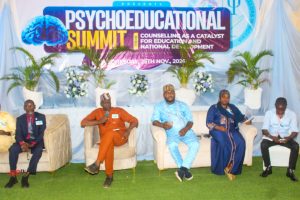
The call was made by the Association of Professional Counsellors of Nigeria (APROCON), at the 2026 Kwara Psychoeducational Summit, with the theme: “Counselling as a Catalyst for Education and National Development,” held in Ilorin.
Speaking on the sidelines of the summit, Prof. Yahaya Lasiele, a professor of Educational Guidance and Counselling, Department of Education, University of Ilorin said counsellors were an important part of the management and running of schools at primary, secondary and tertiary levels.
He said education covers the affective, psychomotor and vocational domains, adding that counselling generally focuses on the affective domain, which relates to the mental health and feelings of students.
“Counsellors are expected to provide different services, including orientation service, familiarising students with the school environment, academic guidance, choice of subjects and career guidance,” he said.
Lasiele said the services were meant to ensure that students were well-adjusted and performed very well in their academic activities.
On insecurity, he said, APROCON had a major role in making society better by guiding students right from the basic school level.
“We guide them, provide guidance, provide information, give them direction, and assist them in making appropriate and correct decisions.
“When you guide the students very well, they are not likely to engage in different negative behaviours such as exam malpractice, kidnapping and so on,” he said.
The expert on counselling called on governments to establish counselling units in each local government area to reach children in and out of school, including those undergoing vocational training, so that they would not be negatively influenced by peers or society.
Also speaking, Prof. Mary Esere, a Professor of Guidance and Counselling in the Department of Counsellor Education, University of Ilorin, said counselling was preventive in nature.
She reiterated the need for counsellors to be posted to schools and allowed to practise, so that drug misuse could be prevented before it started.
Esere said counsellors could not handle substance abuse alone, and therefore proposed a referral pattern where counsellors would cooperate with different stakeholders to assist affected children.
She noted that some drugs in the form of sweets were already finding their way into primary schools, with some children taking them unknowingly.
“When they start abusing drugs, counsellors are in a better position to help in their rehabilitation. They cannot do it by talking alone. They will refer to relevant stakeholders to take care of them,” she said.
In her remarks, the Chairperson, Training Committee, Dr. Busayo Ajibola, said psycho-education was important because it takes counselling beyond the school into the society.
Ajibola said practical exercises for counselling students in 200, 300 and 400 levels had for long been centred in secondary schools, but the association had now begun taking students into communities to sensitise the society.
She said students had been taken to places such as the EFCC, the Correctional Centre and the NDLEA, and to different communities where they spoke on sexual harassment, domestic violence and drug abuse.
“The community was very appreciative, because some of them had never seen counsellors before,” she said.
On challenges facing the association, Ajibola identified awareness and wrong perception about counselling as the greatest challenge.
Ajibola advised that non governmental organisations should collaborate with professional counsellors on issues they were not trained to handle, stressing that collaboration was very important.
She cited interdisciplinary collaboration at the university, where a counselling student could pick a course bordering on health, with a professor from the Teaching Hospital serving as co-supervisor.
In his address, the Kwara Chairman of APROCON, Dr. Usman Jimoh, said the summit brought together counsellors and education stakeholders for psycho-educational propagation.
He explained that the summit has brought together stakeholders to deliberate on the pathway towards bringing success to the educational situation in Kwara State and resolving social crises in the society.
“Our expectation at the end of the day is that stakeholders here represent the interest of society as far as Kwara is concerned.