Dangote Refinery Resumes Naira Loading. Commuters Are paying
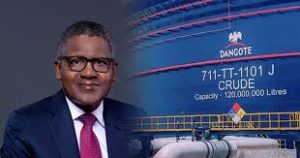
Nigerians across the country are facing mounting economic pressure this week as the retail fuel price has surged to as high as N1,400 per litre. Driven by escalating tensions in the Middle East, global crude oil benchmarks have spiked, heavily influencing domestic pump rates.
Following a brief suspension, the Dangote Refinery has resumed its gantry loading in naira but at a considerably higher ex-depot price. This sudden shift has immediately triggered a sharp increase in transportation fares across major cities like Lagos, Abuja, and Maiduguri, leaving commuters and commercial drivers grappling with the realities of a fully deregulated petroleum market.
Global Crude Oil Shocks and Dangote Refinery’s Move
The current volatility at the pumps is directly tied to the international oil market. Brent crude has officially crossed the $100 per barrel threshold, while the U.S. West Texas Intermediate (WTI) climbed to $92.71 per barrel. Because Nigeria’s petroleum sector is deregulated, these global geopolitical shocks immediately ripple down to local filling stations.
In response to these market realities, the Dangote Refinery recently resumed gantry loading of Premium Motor Spirit (PMS) in naira. This comes after a week-long suspension triggered by challenges in accessing sufficient local crude oil under the Federal Government’s much-discussed naira-for-crude arrangement.
However, the return to naira sales came with a steep cost adjustment. Dangote Refinery increased its ex-depot price from N1,075 to N1,215 per litre, representing a 13.02 per cent jump.
Consequently, major marketers adjusting their own logistics costs have passed this increase down the supply chain.
The Regional Ex-Depot Shifts Fresh loading data reveals that independent marketers are frantically adjusting their pricing boards.
In Lagos, prominent suppliers like A.A. Rano raised their ex-depot price to N1,279 per litre. Other terminals, including Ascon, Gulf Treasure, and African Terminal, moved their rates to N1,275 per litre.
Interestingly, EMADEB marginally reduced its price to N1,274 per litre, highlighting the fierce, albeit limited, competition among depot owners.
Surprisingly, cities like Ibadan and Kano have seen relatively stable transport fares for now, as local union operators carefully monitor the situation before announcing unified fare hikes.
The Naira-for-Crude Bottleneck
The fundamental challenge exacerbating this crisis is domestic supply.
According to Mohammed Kuluwu, the Borno State Chairman of the Independent Petroleum Marketers Association of Nigeria (IPMAN), erratic price fluctuations have made many marketers highly reluctant to load products.
Marketers fear buying at peak prices only to suffer massive losses if the market corrects itself.
Furthermore, energy experts point to systemic administrative bottlenecks. According to Prof. Dayo Ayoade, an energy law expert at the University of Lagos, the Petroleum Industry Act severely limits the government’s ability to intervene in daily pricing.
Prof. Ayoade notes that constraints within the government’s naira-for-crude framework have significantly reduced the volume of crude available for domestic refining.
When local mega-refineries cannot access domestic crude efficiently, they are forced to rely on expensive international frameworks, driving up the final cost of refined petrol for Nigerians.
GlobalPetrolPrices.com: Track International Crude Oil Benchmarks and Local Pump Impacts]
Editorial Takeaway:
Navigating a Deregulated Petroleum Market
The transition to a fully deregulated petroleum market was historically touted as the ultimate solution to Nigeria’s fuel scarcity woes.
However, as Dr. Marcel Okeke, an economist and oil expert, points out, the immediate reality is a worsening cost of living for the populace.
According to industry analysts, simply allowing market forces to dictate prices without a functional safety net or subsidized crude allocation for local refiners will continue to trigger inflationary spikes.
Abdullahi Shehu, a prominent oil and gas analyst, recently urged the Federal Government to supply crude oil to local refineries at heavily subsidized rates, invoiced strictly in naira.
If domestic refiners can source raw materials without foreign exchange volatility, the ex-depot price will stabilize, ultimately offering sustainable relief to millions of Nigerian commuters.
Until these structural supply chains are fixed, citizens will remain highly vulnerable to the unpredictable swings of the global crude oil market.
What are your thoughts on this development? Have transport fares increased in your city? Let us know in the comments below! (iDeemlawful.com)