Don Urges FG To Promote Gender Balance In Educational Leadership, Governance
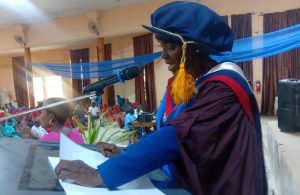
An Expert, Prof. Patricia Etejere, Department of Management Education, University of Ilorin has urged the Federal Government to promote and encourage gender balance in educational leadership and governance to enhance inclusive decision-making.
Etejere made the call during the 298th Inaugural Lecture, titled: “Two Wings, One Bird: Why Education cannot Fly without Gender Equality” held at the University’s Multi-purpose Hall, Ilorin.
According to her, the title of the lecture “Two Wings, One Bird” is a metaphor, used to frame the relationship between education and gender equality in an intuitive yet analytically powerful way.
“Education is conceptualised as a Bird and like a Bird, it is designed to move, rise above limitations, traverse boundaries and carry individuals and societies towards new possibilities,” she said.
The Inaugural Lecturer noted that gender equality represents the two wings of the bird: male and female, adding that each wing is essential, functional and complementary.
The Lecturer noted that gender considerations should be integrated into curriculum design, pedagogy, teacher education, assessment, leadership training, and quality assurance process ro eliminate stereotypes and promote inclusivity
“Accountability mechanism must be established to assess compliance and impact, while government must intentional make efforts to make things work for the female folk.
“Neither wing is superior and neither can fulfil the task of flight alone. The strength, balance, and coordination of both wings determine the bird’s capacity to fly effectively,” she said.
She said that a bird with one constrained wing may flap energetically, but it cannot achieve stable flight. It may move in circles, struggle to gain altitude or remain grounded despite visible effort.
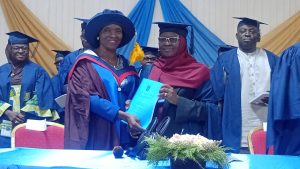
Etejere added that when one gender is disadvantaged in access, participation, leadership, or opportunity, the entire educational system becomes inefficient and fragile.
She further said that progress becomes uneven, outcomes are compromised and sustainability is threatened, stressing that the title challenges the misconception that gender equality is a secondary concern in education.
According to her, a gender-responsive educational system is a collective responsibility that extends beyond the classroom and campus.
“When policymakers provide enabling frameworks, educational managers foster inclusive institutions, families and communities nurture equitable values, education gains the balance and strength required for sustainable national development.
Etejere called for the establishment of a gender-responsive educational system in the country, saying Universities, colleges, and secondary schools should be seen as inclusive spaces where access, participation, achievement and leadership opportunities are equitably distributed
“Such institutions are characterised by gender-sensitive curriculum, inclusive leadership structures and learning environments that actively challenged stereotypes rather than reinforce them.
The Don called for robust translation of policy into practice, saying that education managers including the Vice-Chancellor play very important role in translating policy to practice.
Etejere urged education managers to implement flexible work arrangements, equitable workload distribution and supportive welfare policies to address work-life balances challenges, particularly for women in academia.
She stressed the need for institutional leaders to invest in ICT infrastructure and digital capacity building , ensuring that all staff have equal access to tools that will enhance teaching, research and global engagement.